

Celebrating History Through Art: Mian Situ’s Tributes to Chinese Railroad Workers at Saugus Train Station – Santa Clarita History Center
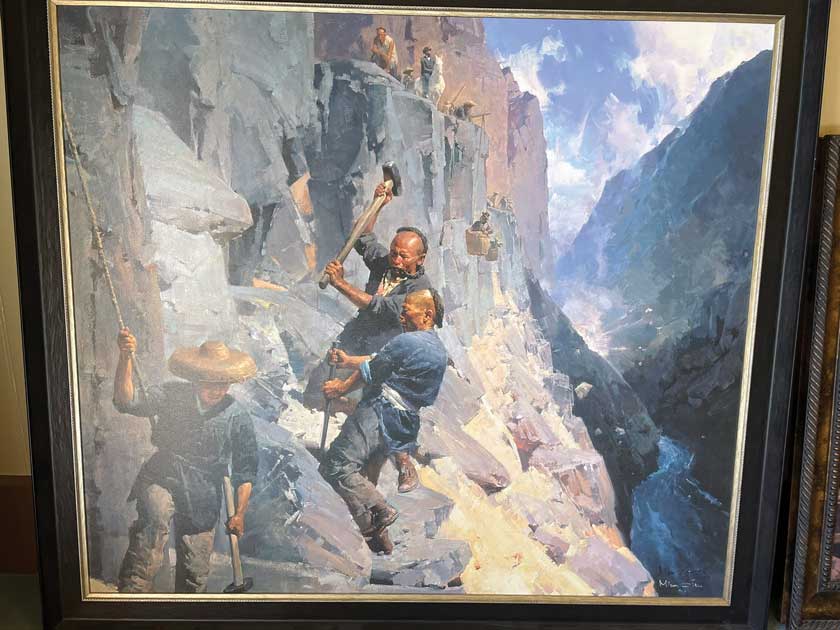
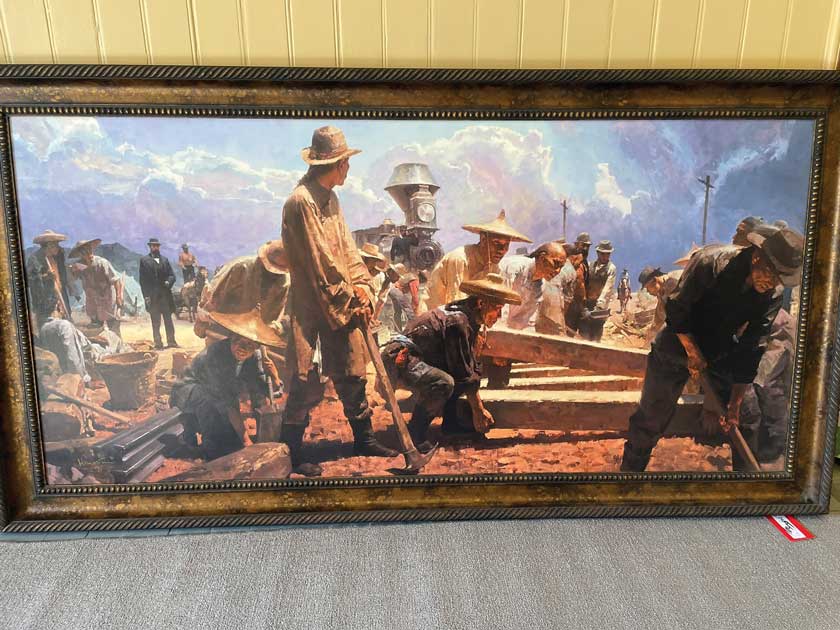
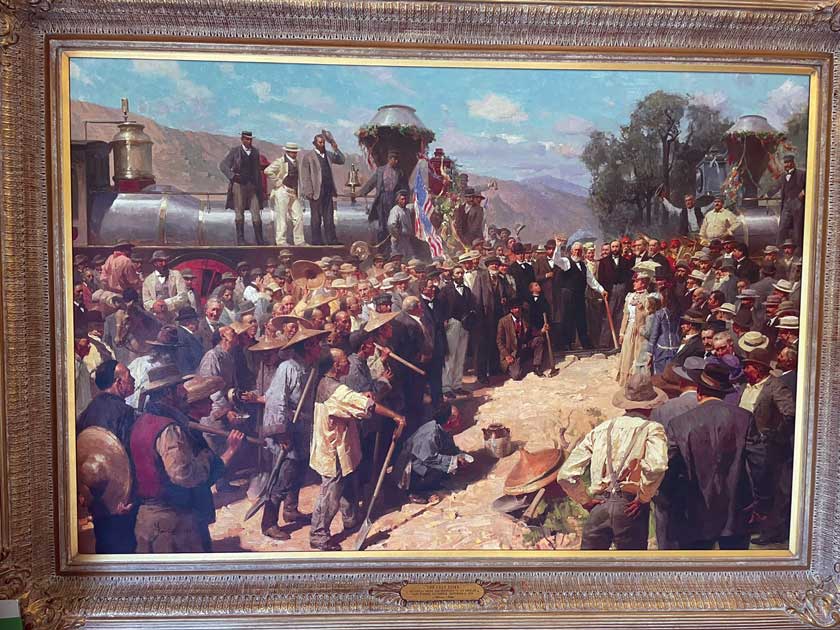
As restoration on the Saugus Train Station in the Santa Clarita History Center continues, two pieces of artwork by Chinese artist Mian Situ have been added to the collection for display in the station’s waiting room. The new pieces join a print already in the Center’s collection and the group will be displayed as a tryptich on one wall of the museum.
The first Situ piece, “The Last Spike” (which was driven at Lang in the Santa Clarita Valley), is a print obtained when the Autry Museum acquired the original oil. In it, some artistic license was used and the people depicted weren’t actually the ones present, as it shows some Chinese workers watching as railroad magnate Charles Crocker waved the golden spike in the air.
Chinese laborers did almost all of the work as the railroad worked its way west from Promontory, Utah, but when the workers got close to the end, Crocker brought in Caucasian men to lay the last pieces of track and made the Chinese workers stay 1,050 feet away so they would not be in any pictures. The irony is that no one brought a camera to the historic driving of the golden spike.
The second and third prints, giclee on canvas signed and framed artist proofs, tell a more accurate story. “10 Miles in One Day” refers to the time Crocker challenged his counterpart at Union Pacific Railroad to see who could lay track faster – Crocker’s Chinese workers or the Irish immigrant workers of the UP. Crocker’s group won by a large margin and the painting depicts the laborers doing the work while the railroad tycoons watch in the background.
“Powder Monkeys,, Cape Horn 1865,” the third print, depicts the sheer cliff in the Sierras (Cape Horn) where the Chinese workers had to lower themselves in buckets and use hand tools to set the dynamite charges (hence the term “powder monkeys”). Construction took a year and more than 300 Chinese workers died in the process. Together, these three pieces tell a more complete story of the historic completion of the transcontinental railroad.
Mian Situ was born in southern China in 1953 and studied art in Guangdong (formerly Canton) He came to the US and Canada in 1987 and sold his artwork in a park for $20 a piece. By 20087, his more desirable works, which showed the Chinese influence in Western American history, were selling for $250,000 to $600,000.
To learn more about our local history, visit www.scvhs.org.
ADVERTISE WITH US

Relay for Life Thanks Sponsors, Event Leaders and Community Participants – American Cancer Society
The American Cancer Society is a 98% volunteer-run organization, and ACS couldn’t achieve its goals without the participation of generous sponsors as well as the work of selfless volunteers. Relay For Life of Santa Clarita Valley would not be possible without...

SCV Water Draft Water Use Efficiency Strategic Plan Available for Review Plan to Be Considered at May 12 Board of Directors Meeting
SCV Water invites customers and other interested parties to review its draft Water Use Efficiency Strategic Plan (WUESP), which is now available for public review. The WUESP is being developed to establish a comprehensive water conservation strategy for the...
Gratitude on Mother’s Day
Everything I need is already within my life. I’ve come to understand that when I slow down, become still, and truly stay present, I can see the abundance that surrounds me every single day. It feels like each of us is a quiet, flowing channel—one that opens...
ABOUT THE MAGAZINE
Santa Clarita Magazine has set a high standard for excellence in advertising for over 36 years. A family owned and operated business, Santa Clarita Magazine has grown with the Santa Clarita Valley since 1990 and become the #1 place to advertise locally.
FOLLOW US
SANTA CLARITA MAGAZINE
PO Box 801570
Valencia Ca 91380
For Advertising information
Call or Text: 1 (661) 294-4444